Culture & community
Salvador’s living heritage
Museums, capoeira, percussion and public traditions bring Salvador’s Afro-Brazilian histories into a living conversation.
Behind the city’s extraordinary color and sound are named institutions, learned practices and people whose work deserves a closer look.
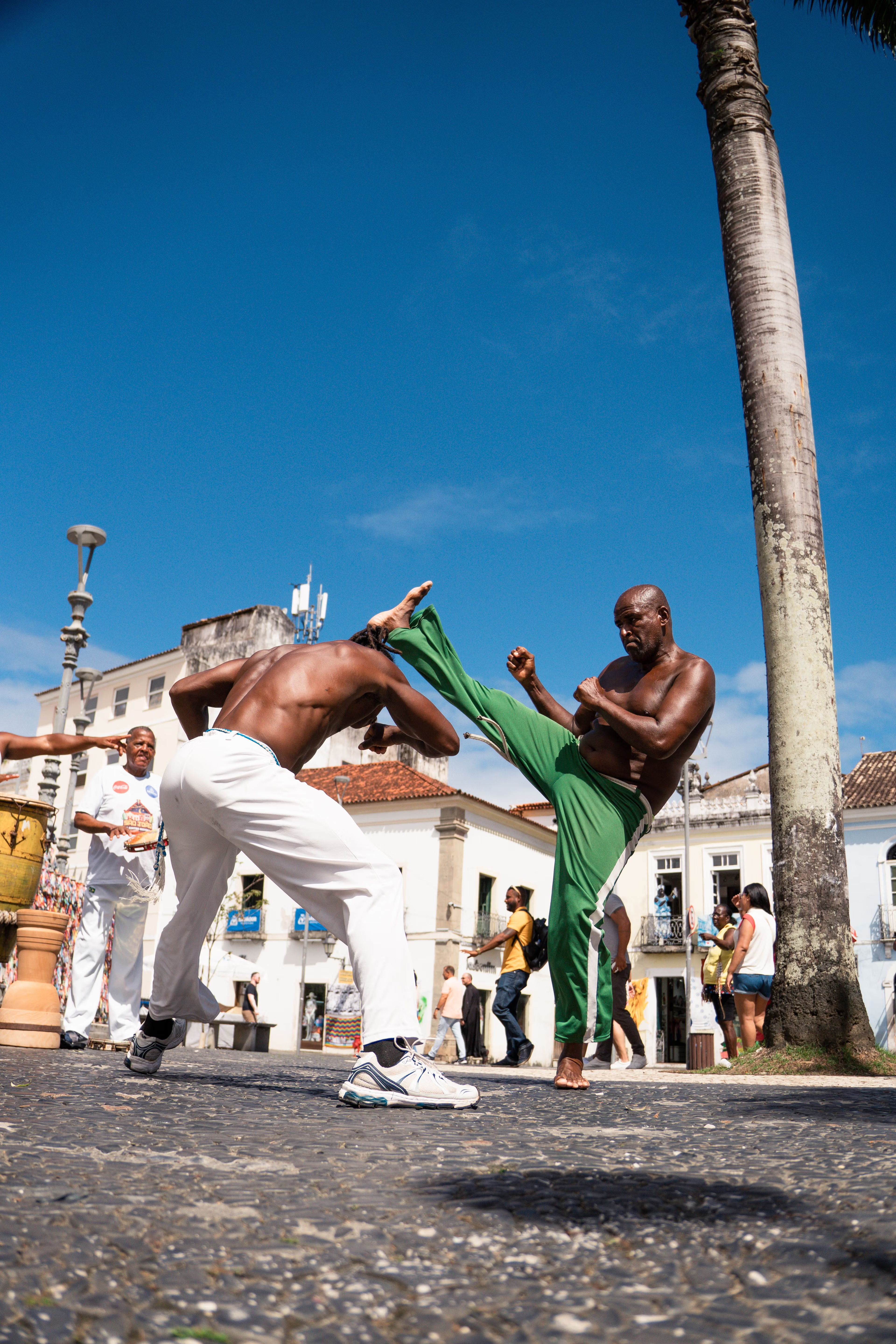
A capoeira circle is easy to photograph and harder to understand. The visible movement draws your eye, but the game also depends on the people making music, the person leading, the song being answered and the decisions shared between the players. If you notice only the acrobatic moment, much of what gives the circle meaning remains outside the frame.
That is a useful starting point for Salvador. Its Afro-Brazilian heritage is present in extraordinarily visible forms: percussion, religious dress, public celebration, food, sculpture and the fabric of the historic center. Those forms are connected to institutions, knowledge and political work that a quick walk cannot fully explain. The pleasure of looking becomes richer when you begin to ask who makes a place, practice or image possible.
There is no single performance that stands for all of this city’s Black cultural life. A museum, a Catholic brotherhood, a bloco afro and a Candomblé community have different histories and purposes. They may share people, references and relationships without becoming interchangeable. Let those differences organize your visit. You will leave with a more specific understanding of the city, and more reasons to return.
Begin with the people behind the picture
The word heritage can suggest something already completed and safely preserved. In Salvador, it is more useful to think about work that continues: teaching a rhythm, maintaining an institution, making an exhibition, organizing a neighborhood event or carrying a religious responsibility. The visible occasion is often the result of effort that took place elsewhere and earlier.
This changes the questions you bring to Pelourinho and the historic center. Instead of treating every doorway as an attractive façade, ask what occupies the building now. Is it a museum, a school, a shop, a place of worship or an organization’s headquarters? If a sign identifies a group, learn its name. A street becomes more intelligible when its institutions stop being anonymous.
The same applies to a performance. A drum does not identify an ensemble, and similar colors do not prove an affiliation. Look for an event announcement or a name supplied by the organizers. That small act keeps the actual musicians in the account, rather than allowing them to dissolve into a general impression of “Bahian atmosphere.”
A useful order for a cultural day
A good cultural day needs more than one kind of encounter. A museum can provide names and historical context. A guided walk can connect that context to the built city. A public music event can show something of a practice in motion. None is a substitute for the others, and you do not need to fit all three into the same afternoon.
Consider choosing one subject to follow across different settings. If carved imagery catches your attention, begin with an institution that interprets it, then look at how another artist uses the body or a material. If percussion is your interest, learn about the organization presenting an event before attending it. Depth can come from a connection, not simply from adding another stop.
Leave time between those encounters. You may want to read a label again, return to a work or sit with a question that a guide has raised. A tightly packed schedule can make culture feel like a succession of entrances, when the more interesting part is often what happens between recognition and understanding.
Two museums, two different conversations
The Museu Afro-Brasileiro da Universidade Federal da Bahia, usually called MAFRO, and the Museu Nacional da Cultura Afro-Brasileira, MUNCAB, should not be confused. Their names may seem close to an unfamiliar visitor, but they are separate institutions. Looking at both as distinct voices is a better approach than treating one as a replacement for the other.
MAFRO’s collections include African and Afro-Brazilian material culture. Its widely known Carybé ensemble consists of twenty-seven carved panels depicting orixás. The works invite attention to gesture, attributes, composition and the expressive possibilities of wood. The museum’s educational material offers a way into that imagery; a quick identification of a figure is only the beginning of looking.
A panel is an artwork with an artist, a material and a history. It is not a complete account of every religious tradition associated with its subject. The distinction matters because museum display can make an image appear self-contained. The beliefs and practices to which it refers live among people whose knowledge extends far beyond what a gallery can show.
MUNCAB places Black artistic production in another conversation, connecting Brazil with Africa and the diaspora through its collection and exhibition program. Its changing displays mean that the visit should begin with what is actually on view for your dates. Read the artist names and exhibition framing, rather than assuming that a permanent idea of “African art” describes everything inside.
Looking beyond the subject of a work
At either museum, start with a few direct observations. What material is being used? How close does the work invite you to come? Is a figure represented frontally, in movement, in fragments or through something left absent? What changes when you look from the side or step back?
Then bring the label into the conversation. It may identify a reference that was not obvious, or complicate an interpretation that initially seemed certain. That is part of the value of a museum visit. A work about memory does not have to illustrate an event literally, and a contemporary Black artist does not have to use a traditional material to enter a discussion of heritage.
Try not to make a single work carry the burden of representing a continent, a religion or an entire city. Two artists can approach related subjects in sharply different ways. The disagreement, contrast or change of emphasis may be exactly what makes the exhibition interesting.
The MUNCAB program is a useful first point of reference for its current exhibitions. Follow the institution’s own description, then allow enough time for the works that do not immediately give up their meaning. A title, a date and an artist’s name are worth retaining when you want to continue reading after the visit.
The Atlantic relationship at Casa do Benin
Casa do Benin introduces a more specific geographic relationship. The institution connects Salvador with the Gulf of Benin through a collection associated with Pierre Verger and through its cultural program. The building’s adaptation also brings Lina Bo Bardi into the story of how a cultural institution can occupy the historic city.
The useful word here is relationship. Africa should not become an undifferentiated origin placed at the beginning of every explanation. Different peoples, places and histories shaped Afro-Brazilian life. An institution focused on Benin provides a chance to become more exact about one part of that much larger account.
Look at how objects are grouped and explained. Does the display emphasize use, material, place, exchange or historical connection? If an object’s purpose is not apparent, resist filling the gap with an assumption based on its shape. A good label or a knowledgeable guide can open a question that a photograph alone cannot answer.
Salvador’s official tourism service reported Casa do Benin’s reopening in August 2026 following restoration work. That recent history is a reminder that cultural access depends on care for buildings and collections, and that an old opening-hours listing may no longer describe the institution accurately. Use current programming when planning the visit.
Architecture as part of interpretation
A cultural building does more than shelter objects. Doorways, courtyards, display supports and the route through rooms influence what visitors notice and how they move. Paying attention to those choices adds another layer to an architecture and city-life visit.
Ask where the building lets the surrounding street enter the experience and where it creates a more concentrated interior. Notice whether a display encourages a close view of a single object or places several works in dialogue. These observations do not require specialist vocabulary. They help you see that interpretation is also made through space.
Hear the institution inside the rhythm
The sound of percussion can travel beyond an event long before you know who is playing. Once you are close enough to listen, try to separate the different parts: the lower pulse, the sharper figures, the entrances and the changes directed across the group. What first seemed like one powerful sound becomes a set of relationships.
That musical complexity has an institutional counterpart. Salvador’s major blocos and percussion organizations are associated with different neighborhoods, histories and educational projects. Some visitors encounter them mainly through Carnival. Their cultural work extends beyond the days when the city receives its largest audiences.
Olodum, founded in the Maciel-Pelourinho area in 1979, offers one example. Its public identity includes music, but the organization also maintains educational and publishing work. Escola Olodum connects arts and culture with anti-racist education; its publishing activity includes material on samba-reggae and Black history. The organization is producing knowledge as well as performances.
This distinction can shape how you spend time and money. An official performance, an institution’s own publication or an announced public activity gives you a named connection with the organization. A shirt bearing a familiar symbol or an unidentified street rhythm does not tell the same story by itself.

Listen for the arrangement
You do not need to know the names of every instrument to listen carefully. Follow one part for a while, then shift your attention to another. Notice whether an instruction changes the whole group at once or whether a phrase passes between sections. Watch how the players remain connected even when their bodies appear to be moving independently.
If singing is part of the performance, remember that words have content. A refrain may be carrying history, praise, criticism or an assertion of identity. Understanding a few translated words later can alter the memory of what you heard. It is more useful than inventing a meaning from the emotional force of the sound alone.
The city’s wider music and culture guide can help you distinguish types of encounters. Choose a public event because you want to hear the people presenting it, rather than because any percussion will do. The specificity is part of the enjoyment.
Ilê Aiyê and the right to define a presence
Ilê Aiyê’s history begins in 1974 in Curuzu, in Salvador’s Liberdade neighborhood. Its own account connects the group’s origins with Antônio Carlos dos Santos, known as Vovô, and with the community around Ilê Axé Jitolu. Its first Carnival appearance followed in 1975.
The significance goes beyond the establishment of another musical group. Ilê Aiyê’s public identity centers Black affirmation, and its educational work carries that emphasis into the production and circulation of knowledge. Reading its history gives a visitor a different understanding of why appearance, language and who occupies public space can matter so much in a celebration.
Do not assume that this history makes Curuzu a stage that is always open to an audience. A neighborhood is also a place where people live, work and go about ordinary days. If you want to attend an Ilê Aiyê event, begin with the organization’s own announcement and the terms of that particular occasion.
The distinction allows a visit to be both interested and ordinary. You can appreciate a public celebration without expecting residents to perform their identities between events. You can also recognize that the place associated with an organization has a life that is larger than its best-known cultural image.
Women leading the sound
Didá adds another distinct history to Salvador’s percussion culture. The organization was founded in 1993 by Neguinho do Samba and is strongly associated with Black women’s participation and leadership in percussion. Salvador’s official account identifies Adriana Portela as a conductor and describes a wider social and educational mission.
It is worth giving that history its own attention. A visitor who describes every ensemble with the name of the most famous group can erase precisely the differences that organizations have worked to establish. Learn the name announced for an event, and use it when you describe what you saw.
Watching a leader direct a group also reveals work that may be missed in a still photograph. A glance, gesture or cue can reorganize a large sound. Musicians need both an individual command of their part and a shared attention to the arrangement. The drama lies in that coordination as much as in the volume.
The difference between visibility and recognition
Visibility means someone has appeared in your picture. Recognition requires more: an accurate name, a sense of what the person or organization is doing and a willingness to let their own account shape yours. You do not have to become an expert to make that effort.
If an event program names the performers, keep it. If a recording or photograph will be shared, check the organizer’s rules and identify the occasion correctly. Where you cannot establish an affiliation, a plain description of what is visible is better than a confident guess.
This is particularly relevant in a city whose imagery circulates widely. Drums, bright dress and historic streets can become generic shorthand in travel photographs. Naming the actual group restores some of the distinction that shorthand removes.
Capoeira is a conversation with rules
Capoeira’s striking movements belong within a social form. UNESCO’s account of the capoeira circle describes a practice in which two players interact while others sing, clap and play instruments. Leadership, musical knowledge and codes of conduct help organize the exchange. Knowledge passes through participation and teaching, not simply through memorizing a sequence of impressive movements.
Watch the relationship between the players. A movement creates a possibility that the other person must read. A response may be quick, restrained, playful or deliberately suspended. The interest is not only in how high someone can lift a leg or how close a body comes to the ground; it is in how the two remain aware of one another.
Then widen your attention to the circle. Listen for the relationship between music and movement. Notice the people whose contribution is less visible to a camera focused on the center. The practice makes more sense when the whole group remains in view.
Watching and learning are different invitations
A public demonstration invites an audience under particular conditions. A class invites learners into another kind of relationship. An ongoing roda may have its own expectations about where observers stand and how participation works. These are related situations, but they do not grant the same kind of access.
If you want to try capoeira, choose a class that explicitly welcomes your level and ask the instructor what participation involves. If you are watching, let the people leading the circle determine its boundaries. You can take a great deal from attentive observation without stepping into the game.
Language can help you move from vague enthusiasm to a more useful exchange. The Portuguese and connectivity guide offers a practical starting point for asking what is happening and understanding an invitation. A small amount of preparation can make it easier to follow an explanation that the teacher or organizer has chosen to give.
A Black Catholic brotherhood has its own history
At the Igreja de Nossa Senhora do Rosário dos Pretos, the history of Black Catholic organization adds another strand to the historic center. Salvador’s account of the brotherhood traces it to 1685 and describes a role extending beyond worship into mutual support and collective life.
The institution should be understood as a Catholic brotherhood with a particular history, not as an interchangeable example of every Afro-Brazilian religious practice. Music, devotion and Black identity can meet here in ways that deserve explanation on their own terms. The presence of a drum or a familiar visual reference does not authorize an observer to assign another religious identity to the congregation.
A church can be an architectural attraction and an active place of worship at the same time. The type of visit changes with what is taking place. A quiet architectural visit allows one kind of looking; a service asks for attention to the congregation and the observance. Follow the institution’s own guidance about visitor access and photography.
Beauty with a social history
It is tempting to begin and end with the building’s color and its position on a photogenic square. Add one more question: who organized to make this institution possible, and what did membership enable people to do together? The question turns architecture into evidence of collective life.
That does not reduce the pleasure of the view. It gives the view another dimension. A façade becomes the entrance to a continuing institution, and the institution becomes a place where historical experience is carried through particular practices rather than preserved only in a written account.
A knowledgeable guide can help make that connection without treating a service as a lecture. Choose the moment for questions with the activity in mind. The people present may be worshippers, caretakers, guides or visitors; their roles are not interchangeable either.
Sacred knowledge is not all public knowledge
Candomblé is central to many accounts of Salvador’s Afro-Brazilian heritage, but a traveler should resist the idea that every important practice is available on demand. A terreiro is a religious community. Its responsibilities and relationships are not organized around completing a visitor’s cultural checklist.
Museums, educational material and guides can introduce histories and concepts. They cannot confer permission to enter a private space, attend a particular ceremony or photograph people. Public events and invitations are specific. Something accessible on one occasion may not be accessible on another.
The same restraint applies to interpretation. Religious dress, an object or a gesture may have meanings that are not apparent to an outside observer. If you do not know, leaving the question open is more accurate than attaching a familiar explanation. It also leaves room for the community’s own account.
This is not a reason to avoid learning. It is a reason to choose settings where explanation is part of the invitation: an institutional program, a public talk, a museum interpretation or an explicitly offered guided experience. The people presenting that encounter can define what it includes.
Make room for more than one identity
No individual should be required to stand for an entire tradition. A musician can also be an educator, a shopkeeper a visual artist, a religious practitioner a student or a parent. A person may choose to discuss one part of their life and leave another private.
The category “Afro-Brazilian” names important histories and relationships, but it does not make all Black residents culturally identical. A thoughtful visit allows people the same complexity that you would expect in your own city. Interest becomes more productive when it begins with what someone is actually presenting rather than with what a visitor hopes they represent.
Food is part of the cultural account
The work of the baianas de acarajé belongs in this wider picture because food involves technique, livelihood, memory and religious relationships. A tray in a public square can be a place of everyday business while carrying a history that is larger than the transaction.
A meal does not require you to master that history before taking a bite. It does invite you to recognize the person doing the work. Learn the dish’s name, understand the choice being offered and give the order your attention. If you want a portrait or a longer conversation, ask separately from buying food.
Our Story At Salvador’s table follows the ingredients and decisions behind acarajé, abará and other foods associated with the city. It offers a closer view of the cooking itself, including why dishes that may look similar should not be collapsed into one description.
The broader food and markets guide can help place that experience within a longer journey. Keep Salvador’s particular knowledge in view as you travel. A dish can move to another city, acquire new customers and remain connected to Bahia without every version being identical.
The ordinary street belongs in the story

After museums and performances, an ordinary walk can feel less eventful. It can also be where the idea of living heritage becomes most tangible. Shops open, goods are arranged, deliveries arrive and people move between work and home. The historic center is functioning as a place, not only as a collection of subjects.
Notice the way a building accommodates current use. A sign, a doorway display or a temporary arrangement of goods can reveal how people work within inherited architecture. These everyday adaptations deserve attention alongside carefully restored interiors. They show that the city’s cultural life is also practical.
That does not mean turning residents into exhibits. Look at the relationship between activity and space, and be thoughtful about where you stand. A narrow passage needed for work is still a passage even when the light makes it attractive for a photograph.
A wider trip through Salvador and Bahia will introduce other settings and communities. Avoid expecting each to reproduce the historic center’s visual vocabulary. The diversity of the state is part of the reason a single photograph or performance cannot stand for all of its cultural life.
Choose encounters with a named context
There are several good ways to begin, depending on the subject that interests you most. The key is to know who is presenting the encounter and what kind of participation has been offered. That makes planning clearer and usually makes the experience more rewarding.
- For visual art: choose a current museum exhibition and retain a few artist names for later reading.
- For music: use an organization’s own public program and learn which ensemble is appearing.
- For capoeira: distinguish an audience event from a class and follow the instructor’s stated level and format.
- For religious history: begin with an institution or guide offering interpretation, and treat access to observance as a separate question.
- For the historic center: combine the built environment with the organizations and businesses occupying it now.
- For food: understand the dish and the maker’s work before turning the encounter into a photograph.
The sequence does not need to become an exhaustive route. A museum visit followed by one well-chosen event can supply more to think about than several rushed stops. Equally, a day devoted to one institution can be enough if its collection or program holds your interest.
Leave with names, not just impressions
A useful memory of Salvador may include a rhythm, a carved gesture, a sentence from an exhibition label or the way a group responded to its leader. Attach a name where you can: artist, institution, organization, dish or place. The detail makes it possible to keep learning after the trip.
It also changes the stories you tell other people. Instead of describing an anonymous cultural spectacle, you can describe a particular encounter and the part of its context you came to understand. Where your knowledge stops, you can say so without losing the pleasure or force of the experience.
The city’s color and energy are real attractions. They become more compelling when they remain connected to the people whose work produces them. Salvador’s living heritage is not waiting to be discovered by a visitor. It is being made, taught, argued over, maintained and celebrated by people with their own reasons for continuing it.
Come ready to look and listen. Then give the names, histories and differences enough room to change what you thought you were seeing.


